
Supplier scorecard: how to turn KPIs into purchasing decisions
- Updated
- 26 August 2026
- Reading time
- 19 min read

A supplier scorecard is a tool for assessing each supplier’s performance and turning its KPIs into purchasing decisions. It should do more than rank suppliers in a table: it should help determine when to reallocate volume, adjust buffers, renegotiate terms, activate alternative suppliers or review a procurement policy.
In many businesses, supplier evaluation remains a descriptive exercise. Teams measure OTIF, review lead times, monitor quality issues or calculate costs, but this data does not always change the way they buy. The problem is not a lack of measurement, but measurement that fails to trigger decisions.
A well-designed supplier scorecard connects performance, risk, cost and planning. It helps purchasing, supply chain and operations teams understand which suppliers are reliable, which introduce variability, which materials need protection and where action is required before poor performance affects service.
What is a supplier scorecard?
A supplier scorecard is an assessment framework that brings together critical performance, risk, cost, quality and service KPIs so that each supplier can be evaluated against comparable criteria. Its purpose is to turn fragmented data into a clear view of supplier reliability and its impact on purchasing planning.
Unlike a one-off assessment, the scorecard should be updated regularly and connected to operational decisions. It is not simply a matter of knowing whether a supplier is performing ‘well’ or ‘poorly’, but of identifying how its behaviour should affect the plan: maintain volume, reduce exposure, increase safety stock, renegotiate terms or seek alternatives.
The scorecard becomes more valuable when it is integrated into the procurement process. A supplier that offers a good price but performs poorly may generate more cost than it appears to. A supplier with a variable lead time may require more inventory. A critical supplier with no alternative may increase planning risk even if its average indicators look acceptable.
Why measuring suppliers is not enough
Measuring suppliers is not enough because a KPI with no associated decision does not improve purchasing planning. A business may have comprehensive reports on deliveries, quality, cost or risk, but if that data does not change purchasing policies, volume allocation or inventory levels, the scorecard becomes little more than a reporting tool.
The difference lies in how it is used. A descriptive scorecard explains what has happened. An actionable scorecard shows what to do next. For purchasing and supply chain teams, this distinction is critical: identifying supplier underperformance too late is of little use if the plan has not included buffers, alternatives or escalation rules.
KPIs that inform but do not drive decisions
KPIs that inform but do not drive decisions show supplier performance without triggering any specific action. Scorecards commonly include delivery, quality, cost or incident metrics that are reviewed periodically without changing volumes, terms or procurement policies.
This approach creates a false sense of control. The organisation believes it is managing suppliers because it measures them, when it is really only documenting their behaviour. For a KPI to create value, it must be linked to a threshold, an owner and an action.
For example, if a supplier’s OTIF falls below a given level over several cycles, the scorecard should trigger a volume review, an improvement plan, a temporary buffer increase or an assessment of alternative suppliers. If nothing happens, the metric is merely informative.
Assessments with no impact on purchasing
Assessments have no impact on purchasing when the scorecard result does not change negotiation, allocation or procurement decisions. The supplier receives a score, but the purchasing team continues to act in exactly the same way.
This is particularly problematic when suppliers show sustained poor performance. If they continue to receive the same volume, terms and level of criticality within the plan, the scorecard loses credibility. The team knows the data exists, but also knows that it changes nothing.
An actionable scorecard must connect assessment and consequence. Not every failure requires the same response, but every material variance should have a defined treatment: monitoring, correction, penalties, renegotiation, reduced dependency or a change of supplier.
Scorecards disconnected from planning
Scorecards disconnected from planning assess suppliers without relating their behaviour to demand, inventory, production or S&OP. This produces only a partial view: the supplier is measured, but its effect on the plan is not understood.
A supplier may offer competitive prices and acceptable quality, but if variable deliveries require the business to hold more stock, reschedule production or expedite transport, its true impact is greater than an isolated assessment suggests.
The scorecard should therefore form part of the purchasing planning process. Its results must inform procurement, inventory and capacity decisions. Otherwise, purchasing measures suppliers on one side while supply chain manages the consequences on the other.
What should a supplier scorecard measure?
A supplier scorecard should measure delivery performance, lead-time variability, quality, total cost, risk and criticality. These indicators make it possible to assess not only whether a supplier meets its commitments, but also how its behaviour affects service, inventory, cash and operational continuity.
The key is not to add as many indicators as possible, but to select those that explain decisions. A good scorecard should answer practical questions: which supplier is reliable, which introduces the most uncertainty, what is the relationship between cost and service, what impact would a failure have, and what action should a change in performance trigger?
OTIF and delivery performance
OTIF measures whether the supplier delivers on time and in the agreed quantity. It is one of the scorecard’s most important KPIs because it directly connects supplier performance with material availability, plan execution and service level.
However, OTIF should not be interpreted in isolation. A supplier may meet 90% of its delivery commitments but fail on critical items. It may also deliver late during periods of high demand, when the operational impact is greater. OTIF should therefore be analysed by supplier, family, material, plant and criticality.
The scorecard must distinguish minor failures from those that put production, service or strategic customers at risk. This view helps prioritise actions and prevents every failure from receiving the same treatment.
Lead-time variability
Lead-time variability measures how far the actual supply time deviates from the expected lead time. It is a critical indicator because a supplier creates risk not only when it takes a long time to deliver, but also when its delivery time is unpredictable.
Planning against an average lead time may be insufficient when variability is high. A supplier that takes anywhere from 7 to 30 days to deliver does not have the same impact as one that consistently delivers in around 15 days, even if their averages are similar. Variability affects safety stock, stock cover, production planning and purchasing commitments.
The scorecard should show not only average lead time but also its stability. This information helps determine whether to increase buffers, review ordering calendars, renegotiate terms or reduce dependency on the supplier.
Quality and non-conformities
Quality and non-conformities measure whether the supplier delivers products, materials or components that meet the agreed requirements. This indicator directly affects production, service, rework costs, returns and confidence in supply.
A supplier may deliver on time and still cause problems if materials arrive with defects, incomplete documentation or incorrect specifications. In such cases, logistics performance does not provide the full picture. The order has arrived, but it is not necessarily available for use.
The scorecard should distinguish minor issues from critical non-conformities. It should also consider recurrence, resolution time and responsibility. If a supplier repeatedly causes quality problems, the response should go beyond merely recording the incident.
Total procurement cost
Total procurement cost measures the true economic impact of buying from a supplier. It extends beyond unit price to include ordering costs, transport, urgent requirements, additional inventory, incidents, quality issues, planning changes and risk.
This approach is essential because the cheapest supplier is not always the most efficient. If it requires more stock, misses deadlines, forces emergency purchases or creates rework, its total cost may be higher than that of a supplier with a higher initial price.
The scorecard should help compare suppliers from a complete economic perspective. This supports more robust decisions on negotiation, volume allocation and purchasing policies, preventing price from concealing material operational costs.
Supplier risk and criticality
Supplier risk and criticality measure the impact that a supply failure would have on operations. Not all suppliers carry the same weight: some are easy to replace, while others provide critical materials, strategic items or support processes with few alternatives.
This indicator should consider dependency, supplier capacity, financial position, location, volume concentration, approvals, geopolitical risk, incident history and the availability of alternatives.
The scorecard should combine performance and criticality. A low-performing, low-criticality supplier may require monitoring. A low-performing, highly critical supplier demands a priority decision: an improvement plan, dual sourcing, a buffer, renegotiation or a search for a backup.

How to turn KPIs into decisions
Turning KPIs into decisions means defining which action is triggered when an indicator exceeds a threshold, shows a worsening trend or affects a critical item. The scorecard should do more than measure suppliers; it should guide purchasing, inventory and planning decisions.
To achieve this, every KPI needs a potential consequence. Poor OTIF may trigger volume reallocation. An unstable lead time may require a larger buffer. A high total cost may justify renegotiation. A critical risk may accelerate the search for alternative suppliers.
Reallocating volume between suppliers
Reallocating volume between suppliers means changing the distribution of purchases according to performance, risk, cost and capacity. If a supplier’s performance deteriorates consistently, the scorecard should help determine whether its share of the portfolio should be reduced.
This decision should not be based on price alone. OTIF, lead time, quality, available capacity, dependency and material criticality must also be considered. Reallocating volume can improve service, reduce risk and increase flexibility, but it may also introduce complexity if it is not managed properly.
The scorecard provides an objective basis for the decision. Instead of relying on perceptions or one-off negotiations, purchasing can use traceable data to explain why a supplier gains or loses volume.
Adjusting inventory buffers
Adjusting inventory buffers means changing safety stock, stock cover or procurement policies according to supplier behaviour. If a supplier is variable, critical or unreliable, additional protection may be required to prevent stockouts.
This does not mean increasing inventory across the board. The scorecard should help determine where financing more stock makes sense and where it does not. A high-risk supplier of a critical material may justify an additional buffer; a low-impact supplier may require monitoring only.
The objective is to balance service and cash. Inventory protects against uncertainty, but it also ties up capital. The decision must therefore consider margin, criticality, lead time, variability and the likelihood of non-performance.
Renegotiating purchasing terms
Renegotiating purchasing terms means adjusting prices, lead times, minimum quantities, service agreements, penalties, calendars or capacity commitments based on the supplier’s actual performance. The scorecard provides evidence for that discussion.
A renegotiation focused solely on price may be insufficient. If the problem is variability, quality or non-performance, the terms should address those causes. Reviewing delivery windows, batch sizes, committed lead times or service levels may matter more than securing a one-off discount.
The scorecard turns negotiation into a discussion about value. Purchasing can demonstrate the impact of variances and propose agreements that are better aligned with planning, rather than unit cost alone.
Activating alternative suppliers
Activating alternative suppliers means preparing or using secondary sources when the primary supplier cannot provide sufficient reliability, capacity or continuity. The scorecard should help identify when this transition needs to begin.
Businesses should not wait for a crisis before seeking alternatives. If the indicators show sustained deterioration, excessive dependency or growing risk, backup suppliers should be assessed before a failure affects production or service.
This decision must balance resilience and complexity. Alternative suppliers can reduce risk, but they also increase the workload involved in approval, management, planning and monitoring. The scorecard helps determine when the trade-off is worthwhile.
How to segment suppliers
Supplier segmentation means grouping suppliers according to impact, risk, criticality and behaviour so that differentiated management rules can be applied. Not every supplier should be assessed to the same level of detail or receive the same response to a variance.
A useful scorecard does not treat a strategic supplier in the same way as one that is easily replaced. Segmentation makes it possible to prioritise time, analysis and decisions. It also prevents purchasing teams from becoming absorbed in an assessment process that is too broad to be actionable.
Strategic suppliers
Strategic suppliers are those with a major impact on the business and a relationship that matters to continuity, competitiveness or differentiation. They may supply key materials, provide technology or specialist capacity, or offer terms that are critical to the plan.
Their scorecard should extend beyond basic compliance. It should assess collaboration, responsiveness, innovation, flexibility, quality, risk, fulfilment of commitments and alignment with planning objectives.
With these suppliers, the decision is rarely to replace them quickly, but to manage the relationship in greater depth. The scorecard should support improvement plans, capacity agreements, forecast collaboration and service commitments.
Critical suppliers
Critical suppliers are those whose failure could directly affect production, service or product availability. Criticality may arise from a lack of alternatives, unique materials, complex approvals, long lead times or concentrated volume.
The scorecard for critical suppliers should use more demanding thresholds and more sensitive alerts. A small deterioration in OTIF, quality or lead time may have a greater impact than it would for a low-criticality supplier.
The main decision with these suppliers is how to reduce exposure. This may involve buffers, dual sourcing, stronger contracts, contingency plans, frequent monitoring or closer integration with planning.
Low-risk suppliers
Low-risk suppliers have a limited operational impact, readily available alternatives and stable performance. They do not require the same level of control as a critical supplier, although they should still meet minimum standards.
In these cases, the scorecard can be simpler and focused on efficiency. Measuring delivery performance, cost, incidents and quality may be enough to detect variances without committing excessive resources.
The key is to avoid overmanagement. A good assessment system also helps determine where not to invest too much time. Planning efforts should focus on the suppliers that can genuinely disrupt the plan.
Replaceable suppliers
Replaceable suppliers can be substituted relatively easily by other approved suppliers or sources available in the market. They represent less risk, although poor management can still affect cost or service.
For this type of supplier, the scorecard can be used to compare performance and negotiate terms. If a replaceable supplier deteriorates, the business has more scope to move volume, review agreements or change its source of supply.
The decision is more tactical than strategic. The scorecard should support objective comparisons and prevent businesses from retaining uncompetitive suppliers through inertia or a lack of monitoring.

What thresholds should the scorecard include?
A supplier scorecard should include thresholds that indicate when a KPI requires monitoring, escalation or a decision. Without thresholds, the scorecard presents data but does not distinguish between acceptable variation and a problem that demands action.
Thresholds should not be the same for every supplier. They must reflect criticality, operational impact, supply risk, cost and the expected service level. An OTIF of 90% may be sufficient for a non-critical supplier, but unacceptable for one that provides key materials.
Operational-impact thresholds
Operational-impact thresholds define when a supplier variance affects production, inventory, service or planning. Their purpose is to prioritise incidents according to their true consequences.
For example, a two-day delay may be irrelevant for a material with ample stock cover, but critical for a component that stops a production line. The threshold must therefore consider impact, not just the numerical variance.
This approach helps avoid unnecessary alerts and focuses attention on what could genuinely disrupt the plan. The scorecard should distinguish between operational noise and actionable risk.
Supply-risk thresholds
Supply-risk thresholds measure when changes in a supplier’s position increase the business’s exposure. They may be based on dependency, concentration, a lack of alternatives, delivery variability, financial circumstances or recurring incidents.
These thresholds matter because risk does not always appear suddenly. Sometimes it accumulates gradually through more delays, more date changes, more incidents, less flexibility or poorer communication. The scorecard should detect this trend before it becomes a crisis.
When a risk threshold is exceeded, the response may include a portfolio review, a search for a backup, a temporary stock increase, an audit, an improvement plan or escalation to purchasing management.
Cost and service thresholds
Cost and service thresholds help determine whether a supplier maintains an acceptable balance between price, performance and operational effort. A supplier may be inexpensive but create indirect costs that undermine the overall result.
These thresholds should account for emergencies, special transport, additional stock, quality incidents, penalties, rework and staff time. If total cost rises above a given level, the decision should not focus solely on renegotiating price.
The scorecard should show when a supplier is no longer competitive in real terms. This makes it possible to compare alternatives using a more complete view of procurement cost.
How to use the scorecard in planning
Using the scorecard in planning means incorporating supplier performance into procurement, inventory, production and S&OP decisions. The supplier ceases to be a record assessed by purchasing and becomes an active variable within the plan.
This approach is essential because purchasing decisions affect the entire chain. An unstable supplier can change stock cover, capacity, production, service and cash. If the scorecard does not feed into planning, the business identifies problems but fails to adapt its plans.
Procurement decisions
Procurement decisions should use the scorecard to define how much to buy, whom to buy from, how often and under what terms. Supplier performance should influence purchasing policy.
For example, a reliable supplier may enable tighter ordering cycles. A variable supplier may require earlier orders, greater stock cover or alternative sources. A supplier with a high MOQ may require a review of batch sizes, frequency or commercial agreements.
The scorecard ensures that procurement is based not only on calculated requirements but also on the reliability of the supplier expected to meet them.
Inventory decisions
Inventory decisions must consider supplier behaviour because supply uncertainty directly affects safety stock, stock cover and the risk of stockouts. An inventory policy cannot be defined without understanding procurement reliability.
If two products have similar demand but very different suppliers, they should not necessarily have the same stock cover. The supplier with a more variable lead time or poorer delivery performance may require greater protection.
The scorecard makes it possible to adjust inventory according to actual risk rather than generic rules. This helps protect service without increasing stock indiscriminately.
Capacity and production decisions
Capacity and production decisions also depend on the scorecard because supplier delays, variability or non-conformities can directly affect the manufacturing plan. A late material can stop a line or force changes to the production sequence.
Production teams need to know which suppliers are reliable and which may introduce constraints. This information helps anticipate risks, review priorities, prepare alternatives or coordinate purchasing earlier.
When the scorecard is connected to production, the business does not wait until a material is missing before responding. It can adjust the plan in advance and reduce disruption.
S&OP decisions
S&OP decisions should incorporate scorecard information when suppliers constrain the aggregate plan. If there is supply risk, limited capacity or dependency on critical materials, the committee needs visibility before approving scenarios.
The scorecard can provide key signals for S&OP: suppliers whose performance is deteriorating, product families exposed to supply risk, critical materials, inventory impact, the need for alternatives or purchasing commitments that affect cash.
In this way, S&OP aligns demand and supply not only in volume terms, but also in terms of reliability, risk and the actual ability to execute.

Common supplier scorecard mistakes
Common supplier scorecard mistakes arise when scorecards are designed as static reports, become overly complex or remain disconnected from planning. The result is a tool that measures a great deal but drives very few decisions.
The first mistake is to include too many KPIs without prioritising them. A scorecard with numerous metrics may appear comprehensive, but if it does not distinguish which ones affect the plan, the team loses focus. It is better to measure fewer indicators and connect them to clear decisions.
Another common mistake is to apply the same criteria to every supplier. Strategic, critical and replaceable suppliers should not be assessed with the same depth or thresholds. Segmentation is essential if the scorecard is to be useful.
Scorecards are also often reviewed too infrequently or only in formal meetings. If supplier performance deteriorates between cycles and the business waits until the next committee meeting to act, the information arrives too late. Critical indicators should trigger exception-based alerts.
Finally, many businesses separate the scorecard from purchasing decisions. They assess the supplier but do not update policies, buffers, volumes or terms. In that case, the scorecard becomes a snapshot of the past rather than a planning tool.
Software for managing scorecards
Supplier scorecard software connects purchasing, delivery, quality, inventory, production and risk data so that suppliers can be assessed using current, actionable information. Its purpose is not simply to display KPIs, but to trigger decisions.
When the scorecard relies on spreadsheets, emails and manual updates, it is difficult to keep it current. Data arrives late, versions are duplicated and decisions lose traceability. In complex environments, this limits the responsiveness of purchasing and supply chain teams.
Connected supplier data
Connected supplier data makes it possible to build a reliable scorecard using real information on orders, deliveries, incidents, quality, costs, lead times, inventory and performance. Without integration, the scorecard relies on partial data.
This connection matters because supplier performance does not reside in a single system. Some of the information sits in purchasing, some in the warehouse, quality, production and planning. Planning software should consolidate this data to provide a useful view.
The more connected the data, the easier it becomes to identify causes and consequences. It is not enough to know that a supplier has failed to meet its commitments; the business also needs to understand the effect on the plan.
Exception-based alerts
Exception-based alerts identify material variances without requiring every supplier to be reviewed manually. The system can issue an alert when OTIF falls, variability increases, incidents accumulate or a risk threshold is exceeded.
The value of these alerts lies in their design. If every variation triggers one, they overwhelm the team. When alerts reflect criticality, impact and trend, they help prioritise decisions.
A good digital scorecard should direct the planner’s and buyer’s attention to where genuine risk exists. This supports earlier action instead of merely explaining afterwards why supply failed.
Decision traceability
Decision traceability shows which indicator changed, what action was taken, who approved it and what outcome it produced. This traceability is essential for improving supplier management over time.
Without traceability, decisions become difficult to evaluate. The business may not know whether reallocating volume improved service, whether a buffer was sufficient or whether renegotiation reduced risk.
Procurement planning software should help close this loop. Measurement, decision-making, execution and learning should form part of the same process.
A supplier scorecard for better purchasing
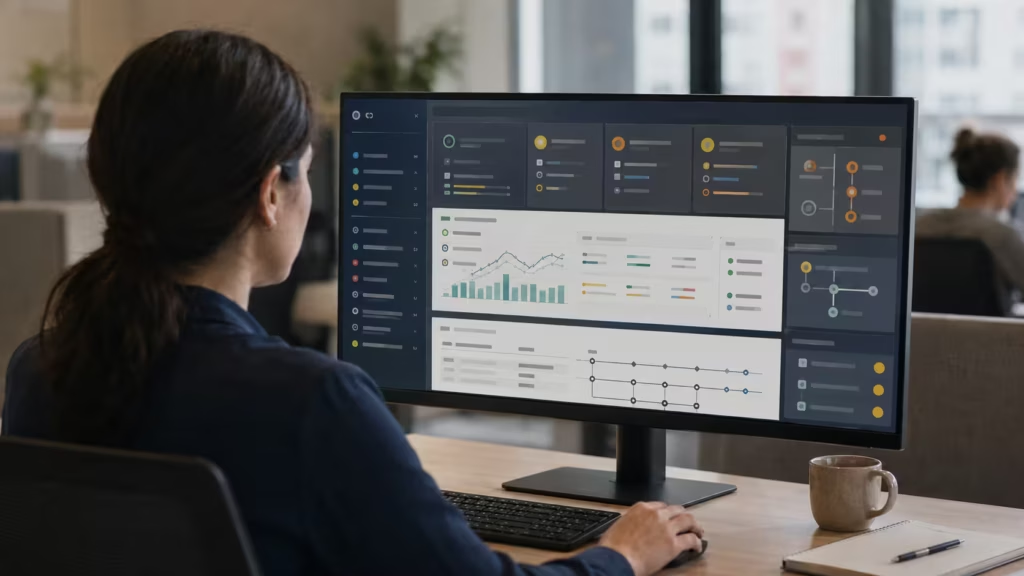
A supplier scorecard supports better purchasing when it turns KPIs into specific planning decisions. Its value lies not only in measuring OTIF, lead time, quality, cost or risk, but in defining what purchasing should do when those indicators change.
This approach helps reduce reactive decisions. Instead of waiting for a stockout, an emergency or a serious variance, the business can anticipate problems, adjust buffers, reallocate volume, renegotiate terms and activate alternative suppliers on a more informed basis.
It also aligns purchasing with supply chain, production, inventory and S&OP. The supplier is no longer assessed solely from a negotiation perspective, but according to its true impact on service, cash, capacity, risk and operational continuity.
At Imperia, we work to ensure that purchasing planning does not depend on isolated assessments or scorecards that merely report information. SCP Studio connects suppliers, procurement, inventory, production and scenarios to turn data into actionable decisions. To see how this approach could be applied in your business, request a demo with our experts.
Related articles
 Procurement and Suppliers
Supplier allocation: how to distribute purchasing without increasing risk or cost
Supplier allocation, or Vendor Allocation Planning, is one of the most important decisions in procurement and…
 Procurement and Suppliers
Commercial purchasing terms: how to stop them breaking your plan
Commercial purchasing terms are not an administrative detail. In many companies, they are one of the main rea…
 Procurement and Suppliers
Constraint-based procurement planning: MOQ, supplier capacity and loading windows
Constraint-based procurement planning has become essential for most industrial organisations. Decisions can n…
 Procurement and Suppliers
Supplier risk in the supply chain: how to anticipate it with data and AI
Supplier risk has become one of the main sources of disruption in today’s supply chains. With globalisation,…
 Procurement and SuppliersProduction and Capacity
Product mix optimisation: how to decide what to make and procure to maximise profitability
Product mix optimisation is one of the most complex decisions and one with the greatest impact on the supply…
 Procurement and Suppliers
OTIF (On Time In Full): how to measure and improve service levels in the supply chain
OTIF (On Time In Full) is a key indicator in the supply chain. Learn what it is, its importance, and how to c…
Subscribe to our newsletter and transform your management!
Receive updates and valuable resources that will help you optimise your purchasing and procurement process.