Planning hierarchy: the framework that aligns strategy, demand and production across your supply chain

Planning hierarchy is one of the most important, yet most overlooked, elements of supply chain management in many industrial organisations. Planning takes place, but it is not always structured. Businesses prepare forecasts, raise purchase orders, schedule production and review budgets. Yet when different decision-making levels are not connected by a clear planning hierarchy, the same problems tend to appear: misalignment, unnecessary costs and a loss of control.
A planning hierarchy is not a theoretical concept. It provides the framework needed to coordinate strategic, tactical and operational decisions, allowing the supply chain to operate as one integrated system. When it is clearly defined, planning can become a competitive advantage. When it is not, friction builds between sales, operations, finance and senior management.
In a volatile environment, with shorter product life cycles and pressure on margins, this structure is critical. The challenge is not simply to forecast how much you will sell. It is to understand how that forecast will affect production capacity, inventory, procurement, service levels and working capital.
The problem: planning in silos
A common mistake in supply chain management is to plan in disconnected layers:
- Senior management sets annual targets without translating them clearly into operational plans.
- Sales develops a forecast without checking production constraints.
- Production plans around urgent requests instead of working from a consolidated view.
- Procurement responds to immediate needs without receiving a structured demand signal.
This approach leads to familiar problems: excess stock in some SKUs, stockouts in others, constant changes to the production schedule, inefficient use of capacity and tensions between departments.
The problem is not usually a lack of data. It is the absence of a planning hierarchy that connects forecast horizons, levels of aggregation and decision owners within a shared framework.
What exactly is a planning hierarchy?
A planning hierarchy organises decision-making across three connected levels:
- Strategic, where capacity, investments, the logistics network and long-term objectives are defined.
- Tactical, where demand and supply are balanced over medium-term horizons, usually through processes such as S&OP.
- Operational, where specific production, procurement and distribution plans are put into action.
Each level has its own planning horizon, level of detail and key performance indicators. They are connected, however, and none can work in isolation. Strategic decisions shape operational capacity, while operational data should feed back into strategic planning.
A well-designed planning hierarchy creates consistency between:
- The business plan and the operations plan.
- The demand forecast and actual capacity.
- Financial objectives and day-to-day execution.
The impact of planning hierarchy: inventory, service levels and profitability
When the planning hierarchy is properly established, the benefits are tangible:
- Lower structural inventory levels, because decisions are less reactive and better coordinated.
- Improved service levels, supported by realistic and aligned plans.
- Greater production stability, with fewer last-minute changes.
- Optimised working capital, by balancing DIO, DSO and DPO from an integrated perspective.
- Better decision-making, based on scenarios and consolidated data.
Ultimately, planning moves from a fragmented process to a governed system.
From theory to practice: implementing a planning hierarchy without creating friction
Defining a planning hierarchy does not mean adding bureaucracy or unnecessary complexity. It means:
- Clarifying roles and responsibilities.
- Setting consistent planning horizons.
- Establishing formal review and consensus-building processes.
- Using tools that provide visibility across functions.
- Maintaining traceability between decision-making levels.
The challenge is organisational and technological, not conceptual. This is where many businesses struggle: their systems are not properly integrated, processes are not formalised or there is no end-to-end view of the operation.
This guide looks at how to structure that hierarchy, which mistakes to avoid and how to turn it into a robust system capable of supporting business growth and increasing complexity.
What will you find in this planning hierarchy guide?
This guide provides a clear explanation of the different levels of planning hierarchy and their role within the supply chain.
It shows you how to connect strategic, tactical and operational planning without creating silos.
It identifies the main mistakes organisations make when structuring their planning processes.
It includes indicators and best practices for assessing the maturity of your current model.
It offers a practical approach to evolving towards integrated, results-oriented planning.
Take the next step towards integrated planning
If your organisation already has planning processes in place but still experiences mismatches between demand, capacity and financial objectives, it may be time to review the structure behind those decisions.
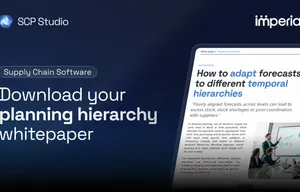
Download the planning hierarchy guide and learn how to align strategy and operations within a single management framework.
If you want to go further, Imperia helps businesses implement integrated planning models through a SaaS supply chain planning solution with generative artificial intelligence that connects demand, production, procurement and S&OP in one environment.
Request a demo to see how a well-defined planning hierarchy can lead to less uncertainty, lower inventory levels and greater profitability.