
Minimum order quantity (MOQ): the silent constraint that can inflate your inventory
- Updated
- 4 March 2026
- Reading time
- 11 min read

Minimum order quantity (MOQ) is often seen as a simple supplier condition. However, in advanced planning environments, MOQ is far more than a commercial requirement. It is a structural constraint that shapes inventory, working capital and margin. When it is not analysed properly, it can quietly drive excess stock and operational rigidity.
With pressure on working capital, volatile demand and the need for end-to-end efficiency, accepting MOQ without building it into your planning model is a common mistake. The aim is not just to comply with it. The aim is to understand its system-wide impact and manage it as a strategic decision within Supply Chain Planning.
What minimum order quantity (MOQ) is and why it is not just a commercial condition
Minimum order quantity (MOQ) is the minimum volume a supplier requires for each purchase order. It typically exists to cover fixed production, transport or handling costs. From a contractual perspective, it can look like a simple operational parameter.
From a supply chain perspective, however, MOQ sets the minimum replenishment lot size and therefore determines inventory levels, ordering frequency and capital use. It is not only a commercial clause. It is a design variable in the logistics and financial system.
Supplier-imposed MOQ vs strategically defined MOQ
In many cases, companies treat the supplier’s MOQ as non-negotiable. This reactive approach limits the ability to optimise inventory and leads to purchasing decisions that are disconnected from the overall plan.
There is another way to look at it: defining an internal, strategic MOQ. This means assessing whether the minimum quantity you accept makes sense given real demand, product turns and the company’s financial capacity. In some cases, it is worth negotiating different terms or even switching suppliers if MOQ creates structural inefficiency.
How MOQ affects the entire supply chain flow
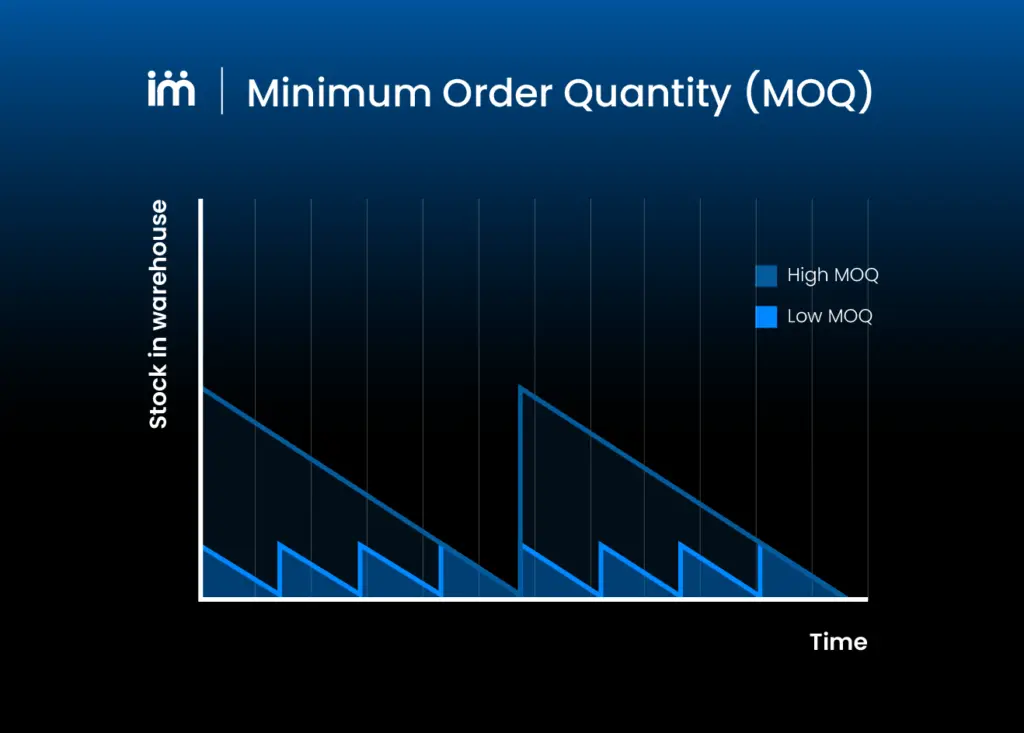
Every time an MOQ-driven order is triggered, the system receives a volume that can exceed the true requirement for that period. The excess becomes inventory that must be stored, financed and managed until it is consumed.
This affects the entire flow. It alters stock cover, changes future purchasing plans and can create artificial inventory peaks. It also influences production planning when the materials you have bought push you towards making certain batches to avoid accumulation.
MOQ does not only affect purchasing. It affects flow design.
The real financial impact of MOQ on inventory and margin
One of the most common mistakes is evaluating MOQ purely through unit price. Buying more to get a better cost per unit can look efficient. However, that narrow view ignores the total financial impact.
MOQ directly affects working capital, the cash cycle and the business’s real margin. It is a decision that goes beyond operations and straight into finance.
Working capital, cash cycle and cost of capital
Every additional unit purchased to meet an MOQ represents tied-up capital. That capital is no longer available for other investments and it creates an explicit or implicit financing cost.
When turns are low, the cash cycle lengthens and the company funds inventory that does not generate immediate revenue. Across multiple SKUs with high MOQs, the aggregated impact can be significant.
The key question is not how much you save per unit but how much capital you are committing and for how long.
The hidden cost of structural overstock
MOQ-driven overstock does not always look like an immediate problem. It often blends into total inventory without anyone questioning its source. Yet it creates recurring costs for storage and handling and increases the risk of deterioration or obsolescence.
In broad portfolios, this effect can become structural. The company operates permanently with inventory levels above what is needed to cover demand and safety stock. That build-up erodes efficiency without adding value.
How MOQ affects deliverable margin
The theoretical margin calculated at the point of purchase does not capture MOQ’s full impact. If inventory takes longer to sell, if discounts are needed to clear stock or if additional storage costs appear, deliverable margin falls.
Real profitability depends on total inventory lifecycle cost, not only unit price. Factoring MOQ into margin analysis helps ensure decisions match operational reality.
Key interactions: MOQ, EOQ and safety stock
MOQ does not operate in isolation. It interacts with other key inventory variables, especially economic order quantity (EOQ) and safety stock.
When these variables are not aligned, the system can generate unnecessary inventory without anyone challenging it.
Differences between MOQ and economic order quantity (EOQ)
EOQ aims to minimise total cost by balancing ordering costs and holding costs. It is an internal optimisation based on the company’s own cost structure.
MOQ, by contrast, is typically set by the supplier. It may or may not match the optimal EOQ. When MOQ is higher than the calculated EOQ, the business is forced to order more than is economically efficient under its internal model.
That divergence is a warning sign that should be assessed strategically.
How combining MOQ and safety stock can inflate inventory
When a high MOQ is combined with poorly sized safety stock, the result is excessive cover. Inventory builds up in two ways: through mandatory ordering and through “protection” against uncertainty.
Across multiple SKUs, this multiplier effect can push total inventory far above what is needed to sustain service.
When MOQ creates structural inventory that is hard to absorb
The issue becomes worse when demand is lower than MOQ or consumption is irregular. In those cases, every order brings in more inventory than the market can absorb in the short term.
Over time, structural inventory accumulates and requires promotions, discounts or production adjustments to clear. MOQ stops being a one-off condition and becomes a constant source of inefficiency.

MOQ in high-variability environments
In stable-demand contexts, MOQ can be managed relatively easily. The challenge appears when variability increases.
In dynamic environments, MOQ rigidity conflicts with the need for flexibility.
Intermittent demand and slow-moving products
For slow-moving products or intermittent-demand items, a high MOQ can mean months of cover in a single order. This increases obsolescence risk and distorts planning.
The purchasing decision stops matching the real pace of the market.
Seasonality and accumulation risk
For seasonal products, ordering under a high MOQ outside peak demand can create build-up before or after the season. If forecasts miss, residual inventory hits margin directly.
Synchronising MOQ with the seasonal cycle is critical to avoid overstock.
Short lifecycle products and obsolescence risk
In short lifecycle sectors such as technology or fashion, MOQ can be particularly risky. A large lot can become obsolete before it is fully consumed.
In these cases, accepting MOQ should be assessed through a much stricter risk lens.
How to optimise MOQ with advanced planning
Optimising MOQ is not only about negotiating better terms with suppliers. It requires integrating the decision into the wider planning model and assessing its system impact on inventory, capital and margin. An MOQ that looks attractive on price can be financially inefficient when viewed in the full context of the system.
The shift is moving from a tactical purchasing decision to a decision modelled within Supply Chain Planning.
Analysing total cost beyond unit price
Assessing MOQ purely through volume discount is a common mistake. The analysis should include cost of capital, storage, obsolescence risk and the effect on deliverable margin.
For example, if a product’s optimal EOQ is 1,000 units but the supplier sets an MOQ of 1,500, those extra 500 units might represent several additional weeks of cover. If the annual cost of capital is 8% and the product turns slowly, a 3% volume discount can be fully offset by the cost of carrying tied-up inventory.
This approach answers a critical question: does the volume discount genuinely outweigh the total lifecycle cost of the inventory? Once you bring in that broader view, many decisions that look efficient stop being so.
Simulating scenarios before committing to purchases
Advanced planning allows you to simulate what happens if you accept a given MOQ: how cover evolves, how much extra capital is tied up and how cash flow is affected.
Take an item with average monthly demand of 400 units and an MOQ of 2,000. Each order means five months of initial cover. If the forecast is off by 20%, residual stock can linger for several additional months, affecting both space and working capital.
Simulation makes these scenarios visible before the purchase order is placed. Rather than reacting once inventory is already in the warehouse, the business can anticipate the impact and decide, based on data, whether to accept that MOQ or explore alternatives.
Integrating the decision into the overall Supply Chain Planning model
MOQ needs to be assessed alongside demand forecasting, safety stock, financial capacity and service policies. It cannot be evaluated in isolation.
For example, if an item already requires 30 days of safety stock and MOQ adds a further 45 days of cover, the business can end up operating with more than 75 days of inventory without ever making that decision explicitly. This accumulation can distort key indicators such as turns, average cover or capital employed.
Once MOQ is integrated into the full planning model (including demand scenarios, financial constraints and service targets) it stops being a fixed value in the ERP and becomes an optimisable variable. Only then can it be managed without creating knock-on effects that erode margin and flexibility.

From operational constraint to strategic decision
Maturity in MOQ management comes when it stops being treated as an external imposition and becomes a strategic variable. At that point, the organisation stops reacting to supplier terms and starts assessing the impact on inventory, service and profitability. It becomes a conscious choice within the operating model, not a contractual condition accepted without challenge.
Aligning procurement, operations and finance
Procurement may push for better prices, operations for stability and finance for lower tied-up capital. Without alignment, MOQ becomes a source of internal friction, with each function optimising for its own goal without considering the overall impact. The result is often oversized inventory or efficiency loss that is hard to trace back to a single decision.
An integrated approach makes trade-offs explicit and decisions are made based on total impact. This means quantifying the volume saving against the financing cost of additional inventory and the operational risk that comes with it. When all three functions work from the same data and scenarios, the conversation shifts. It stops being about “buying cheaper” and becomes about choosing the option that creates the most value for the business overall. That alignment turns MOQ into a shared strategic variable rather than a recurring conflict.
Turning MOQ into a lever for efficiency
When managed well, MOQ can help consolidate purchasing, improve logistics efficiency and stabilise production. In certain contexts, larger lot sizes can reduce ordering frequency, simplify transport and bring more predictability to planning. The difference is whether it is built into the plan and assessed rigorously for real impact.
Making MOQ a lever for efficiency means understanding where it adds value and where it creates unnecessary rigidity. Not all products or suppliers should be managed under the same logic. Once you segment by criticality, turns and margin, the business can accept high MOQs for strategic items and seek flexibility elsewhere. In this way, MOQ stops being a source of structural inefficiency and becomes part of an optimised flow design.
MOQ within a data-driven planning system
In advanced planning, MOQ is not a static number in the ERP. It is a variable that is analysed, simulated and reviewed regularly as demand patterns and financial context evolve. Market conditions change, consumption patterns shift and financial capacity fluctuates. Keeping the same MOQ without review can create cumulative inefficiency.
A data-driven system allows continuous assessment of whether MOQ still fits operational reality. This includes tracking real turns, average cover, impact on working capital and margin sensitivity to volume changes. When MOQ is built into processes such as S&OP or the procurement planning cycle, it stops being a legacy parameter and becomes part of active supply chain governance. That is where management becomes truly strategic.
MOQ is not data, it is a system design decision
Minimum order quantity is not a neutral figure or a simple contractual requirement. It is a variable that determines structural inventory levels, working capital and operational flexibility. When it is accepted without modelling its impact, the company is redesigning its supply flow without ever deciding to do so explicitly.
Mature organisations do not only ask what the supplier’s MOQ is. They ask whether their system can absorb it without destroying value. They assess how much additional inventory it creates, what it does to the cash cycle and how it changes turns and deliverable margin. In other words, they turn a commercial condition into a data-driven strategic decision.
In an environment of increasing volatility and constant financial pressure, competitive advantage does not come from negotiating the biggest volume discount. It comes from understanding the total cost of every procurement decision. MOQ stops being an external imposition once it is integrated into the overall planning model and assessed alongside demand, capacity and financial objectives.
Because in advanced Supply Chain Planning, there are no innocent parameters. Every constraint you accept reshapes the system. The difference between a reactive supply chain and a strategic one is not complying with conditions. It is consciously designing how and when to take them on. If you would like to see how MOQ can be modelled within a real planning process (demand, safety stock, purchasing scenarios and financial constraints), we can help at Imperia. With SCP Studio, you can simulate the impact of MOQ by SKU and supplier, quantify tied-up capital and see how cover and deliverable margin change before committing the order. Request a demo and we will show you how to run this analysis for your items, your suppliers and your real constraints.
Related articles
 Procurement and Suppliers
Supplier scorecard: how to turn KPIs into purchasing decisions
A supplier scorecard is a tool for assessing each supplier’s performance and turning its KPIs into purchasing…
 Procurement and Suppliers
Supplier allocation: how to distribute purchasing without increasing risk or cost
Supplier allocation, or Vendor Allocation Planning, is one of the most important decisions in procurement and…
 Procurement and Suppliers
Commercial purchasing terms: how to stop them breaking your plan
Commercial purchasing terms are not an administrative detail. In many companies, they are one of the main rea…
 Procurement and Suppliers
Constraint-based procurement planning: MOQ, supplier capacity and loading windows
Constraint-based procurement planning has become essential for most industrial organisations. Decisions can n…
 Procurement and Suppliers
Supplier risk in the supply chain: how to anticipate it with data and AI
Supplier risk has become one of the main sources of disruption in today’s supply chains. With globalisation,…
 Procurement and SuppliersProduction and Capacity
Product mix optimisation: how to decide what to make and procure to maximise profitability
Product mix optimisation is one of the most complex decisions and one with the greatest impact on the supply…
Subscribe to our newsletter and transform your management!
Receive updates and valuable resources that will help you optimise your purchasing and procurement process.