
Minimum Order Quantity (MOQ): The Hidden Constraint That Can Drive Up Inventory
- Updated
- March 4, 2026
- Reading time
- 9 min read

Minimum order quantity (MOQ) is often treated as just another supplier requirement. In reality, within advanced planning environments, MOQ is much more than a commercial term. It is a structural constraint that shapes inventory levels, working capital and margin. When it is not properly modeled, it quietly fuels excess stock and operational rigidity.
In a context of tight working capital, volatile demand and the need for end-to-end efficiency, accepting MOQ without embedding it into your planning logic is a common mistake. The objective is not simply to comply. It is to understand its system-wide consequences and manage it as a deliberate decision within Supply Chain Planning.
What Minimum Order Quantity (MOQ) Really Means Beyond a Contract Term
Minimum order quantity (MOQ) is the smallest volume a supplier requires per purchase order. It usually exists to offset fixed production, transportation or handling costs. From a contractual standpoint, it may look like a basic operational parameter.
From a supply chain standpoint, however, MOQ defines the minimum replenishment lot and therefore influences inventory levels, order frequency and capital allocation. It is not just a commercial clause. It is a design input for your logistics and financial system.
Supplier-Driven MOQ vs Strategically Defined MOQ
Many companies accept supplier MOQs as untouchable. This reactive stance limits inventory optimization and disconnects purchasing decisions from the broader plan.
A more mature approach is to define a strategic, internal view of MOQ. This means evaluating whether the minimum quantity truly aligns with actual demand patterns, product turns and financial capacity. In some cases, it may make sense to renegotiate terms or even reconsider the supplier relationship if MOQ structurally undermines efficiency.
How MOQ Reshapes the Entire Supply Chain Flow
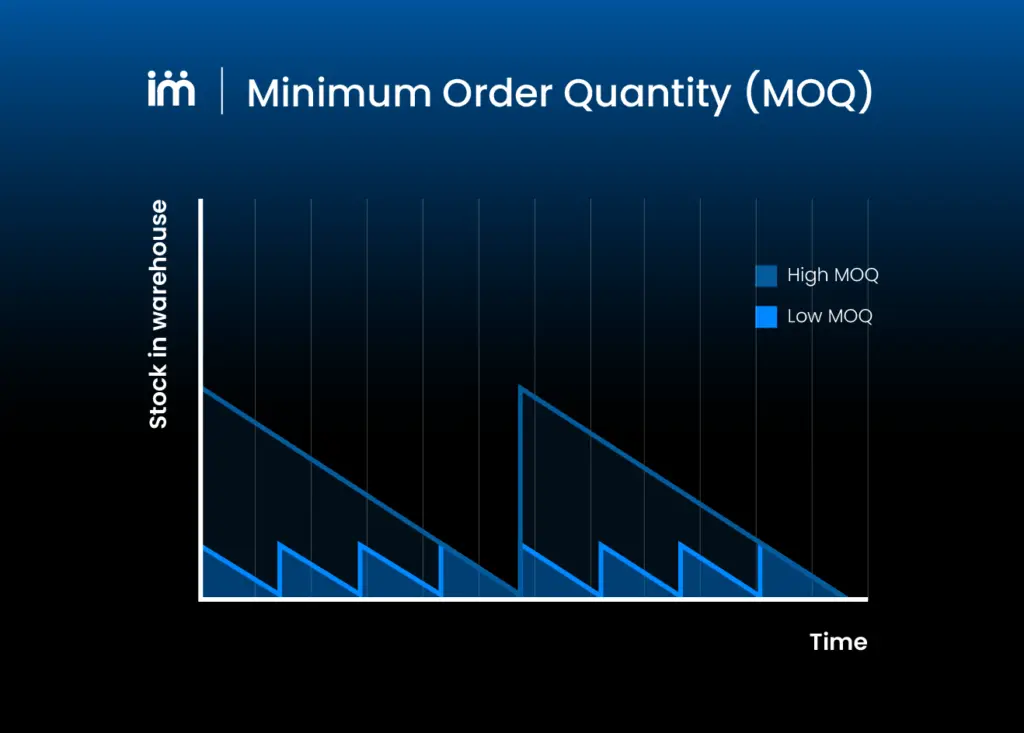
Every time an order is placed to satisfy MOQ, the system receives a volume that may exceed the real need for that period. The surplus becomes inventory that must be stored, financed and managed until consumed.
This impacts the entire flow. It changes days of cover, affects future replenishment logic and can generate artificial inventory peaks. It may also influence production planning, especially when purchased materials push manufacturing toward specific batches just to avoid stock accumulation.
MOQ does not only affect procurement. It redefines how the flow operates.
The Real Financial Impact of MOQ on Inventory and Margin
A common error is evaluating MOQ solely through unit cost. Buying more to secure a lower price per unit may appear efficient. However, this narrow lens ignores the full financial impact.
MOQ directly influences working capital, the cash conversion cycle and real profitability. It is not just an operational issue. It is a financial decision.
Working Capital, Cash Cycle and Cost of Capital
Every extra unit purchased to meet MOQ ties up capital. That capital is no longer available for other investments and carries either explicit or implicit financing costs.
If product turns are low, the cash cycle stretches and the company funds inventory that does not generate immediate revenue. Across multiple SKUs with high MOQs, the cumulative effect can be substantial.
The key question is not how much you save per unit, but how much capital you are locking in and for how long.
The Hidden Cost of Structural Overstock
MOQ-driven overstock rarely appears as an urgent problem. It blends into total inventory without raising immediate concern. Yet it generates ongoing storage and handling costs and increases exposure to deterioration and obsolescence.
In large portfolios, this can become structural. The company consistently operates with inventory levels above what is required for demand and safety stock. The excess erodes efficiency without creating additional value.
How MOQ Impacts Deliverable Margin
The margin calculated at the time of purchase does not reflect the total effect of MOQ. If inventory takes longer to move, if markdowns are required to clear stock or if additional storage costs arise, deliverable margin declines.
True profitability depends on the total lifecycle cost of inventory, not just purchase price. Incorporating MOQ into margin analysis ensures decisions reflect operational reality.
Critical Interactions: MOQ, EOQ and Safety Stock
MOQ does not function in isolation. It interacts with other key inventory drivers, particularly economic order quantity (EOQ) and safety stock.
If these variables are not aligned, the system can generate unnecessary inventory without anyone explicitly approving it.
MOQ vs Economic Order Quantity (EOQ)
EOQ seeks to minimize total cost by balancing ordering and holding costs. It is an internally optimized calculation based on your own cost structure.
MOQ, on the other hand, is usually supplier-imposed. It may not align with the calculated EOQ. When MOQ exceeds EOQ, the business is forced to order more than is economically optimal under its own model.
That gap is a strategic signal that requires analysis.
How MOQ Combined with Safety Stock Can Inflate Inventory
When a high MOQ is layered on top of poorly calibrated safety stock, inventory inflation follows. Stock increases both through mandatory lot sizes and through protection buffers.
Across a wide SKU base, this compounding effect can push total inventory well beyond what is necessary to maintain service.
When MOQ Creates Structural Inventory
The problem intensifies when demand is lower than MOQ or consumption is irregular. In such cases, every order injects more inventory than the market can absorb in the short term.
Over time, structural inventory accumulates and requires promotions, markdowns or production shifts to unwind. MOQ stops being a one-time constraint and becomes a persistent source of inefficiency.
MOQ in High-Variability Environments
In stable demand settings, MOQ can be managed with relative ease. The challenge emerges when variability increases.
In dynamic environments, MOQ rigidity clashes with the need for flexibility.
Intermittent Demand and Slow Movers
For slow-moving products or intermittent items, a high MOQ can translate into months of supply in a single order. This heightens obsolescence risk and distorts planning logic.
Purchasing decisions drift away from actual market rhythm.
Seasonality and Accumulation Risk
For seasonal items, placing high-MOQ orders outside peak periods can generate inventory build-up before or after the season. If forecasts are off, leftover stock directly impacts margin.
Aligning MOQ with the seasonal cycle is essential to prevent excess.
Short Lifecycle Products and Obsolescence
In short lifecycle industries such as technology or fashion, MOQ carries amplified risk. A large lot can become obsolete before full consumption.
In these cases, accepting MOQ requires a stricter risk assessment.

How to Optimize MOQ Through Advanced Planning
Optimizing MOQ goes beyond negotiating with suppliers. It requires embedding the decision into the overall planning framework and assessing its impact on inventory, capital and margin. A price advantage at purchase may translate into financial inefficiency at system level.
The real shift is moving from a tactical procurement choice to a decision modeled within Supply Chain Planning.
Evaluating Total Cost Beyond Unit Price
Analyzing MOQ purely through volume discount is misleading. The assessment must include cost of capital, storage, obsolescence risk and the impact on deliverable margin.
For instance, if EOQ is 1,000 units and supplier MOQ is 1,500, the additional 500 units may represent weeks of extra cover. With an 8% annual cost of capital and slow turns, a 3% discount can easily be offset by holding costs.
The critical question becomes whether the discount truly compensates for total lifecycle cost.
Simulating Scenarios Before Placing Orders
Advanced planning tools allow you to simulate the impact of accepting a specific MOQ: how days of cover evolve, how much capital is tied up and how cash flow shifts.
Consider an item with monthly demand of 400 units and an MOQ of 2,000. Each order represents five months of initial cover. If forecast error reaches 20%, residual stock may linger for several additional months.
Simulation makes these outcomes visible before the order is issued. Instead of reacting once inventory is in the warehouse, the company can make an informed decision in advance.
Integrating MOQ into the Full Planning Model
MOQ must be evaluated alongside demand forecasts, safety stock, financial capacity and service policies. It cannot stand alone.
If safety stock already requires 30 days of cover and MOQ adds another 45 days, the company may unknowingly operate with over 75 days of inventory. This accumulation distorts metrics such as turns, average cover and capital employed.
When MOQ is fully integrated into demand scenarios, financial constraints and service targets, it becomes an optimizable variable rather than a static ERP parameter.

From Operational Constraint to Strategic Variable
True maturity in MOQ management begins when it is no longer seen as an external imposition but as a strategic variable. The organization moves from reacting to supplier terms to assessing impact on inventory, service and profitability.
Aligning Procurement, Operations and Finance
Procurement may pursue lower prices, operations may seek stability and finance may prioritize capital efficiency. Without alignment, MOQ becomes a source of friction and oversized inventory.
An integrated approach quantifies trade-offs. Volume savings are weighed against financing costs and operational risk. When all functions share the same data and scenarios, the conversation shifts from “cheaper buying” to “higher value creation.”
Using MOQ as an Efficiency Lever
When properly managed, MOQ can consolidate purchases, improve logistics efficiency and stabilize production. Larger lot sizes can reduce order frequency and enhance predictability.
The key is segmentation. High MOQs may make sense for strategic, high-turn items, while flexibility is preferable for volatile SKUs. Managed this way, MOQ supports optimized flow design rather than structural inefficiency.
MOQ Within a Data-Driven Planning System
In advanced planning environments, MOQ is not a fixed ERP field. It is continuously analyzed and reviewed as demand, market conditions and financial context evolve.
Tracking real turns, average cover, working capital impact and margin sensitivity ensures MOQ remains aligned with operational reality. Integrated into S&OP and procurement planning cycles, it becomes part of active supply chain governance.
MOQ Is Not Just Data, It Is a System Design Choice
Minimum order quantity is not a neutral number or a simple contractual clause. It defines structural inventory, working capital usage and operational flexibility. Accepting it without modeling its impact effectively redesigns your supply flow without deliberate intent.
Mature organizations go beyond asking what the supplier’s MOQ is. They assess whether their system can absorb it without destroying value. They quantify added inventory, impact on cash cycle and effect on turns and deliverable margin.
In volatile markets with constant financial pressure, competitive advantage does not come from negotiating the biggest discount. It comes from understanding the total cost of every procurement decision. Once MOQ is embedded into the full planning model and evaluated alongside demand, capacity and financial objectives, it shifts from external constraint to strategic lever.
Because in advanced Supply Chain Planning, no parameter is neutral. Every constraint reshapes the system. The difference between a reactive supply chain and a strategic one is not compliance. It is intentional design.
If you want to see how MOQ can be modeled within a real planning framework including demand, safety stock, purchasing scenarios and financial limits, we can help at Imperia. With SCP Studio, you can simulate MOQ impact by SKU and supplier, quantify tied-up capital and understand how cover and deliverable margin shift before placing an order. Request a demo and we will walk you through the analysis using your items, your suppliers and your real constraints.
Related articles
 Procurement and Suppliers
Supplier scorecard: how to turn KPIs into procurement decisions
A supplier scorecard evaluates each supplier’s performance and turns its KPIs into procurement decisions. It…
 Procurement and Suppliers
Supplier Allocation: How to Distribute Purchasing Without Increasing Risk or Cost
Supplier allocation, also known as Vendor Allocation Planning, is one of the most important decisions in proc…
 Procurement and Suppliers
Commercial Purchasing Terms: How to Stop Them From Breaking Your Plan
Commercial purchasing terms are not just an administrative detail. In many companies, they are one of the mai…
 Procurement and Suppliers
Constraint-Based Procurement Planning: MOQ, Supplier Capacity and Loading Windows
Constraint-based procurement planning has become essential for most industrial organizations. Purchasing deci…
 Procurement and Suppliers
Supplier Risk in the Supply Chain: How to Get Ahead of It With Data and AI
Supplier risk has become one of the biggest drivers of disruption in modern supply chains. As networks global…
 Procurement and SuppliersProduction and Capacity
Product Mix Optimization: How to Decide What to Make and Buy to Maximize Profitability
Product mix optimization is one of the hardest decisions in supply chain management and one of the most conse…
Subscribe to our newsletter and transform your management!
Receive updates and valuable resources that will help you optimize your purchasing and procurement process.